7 Days, 7 Continents: Lincoln Bode’s World Marathon Challenge for Parkinson’s Research
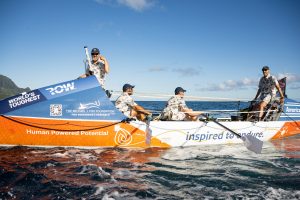
Whether rowing the Pacific Ocean or running across multiple continents, the spirit of Human Powered Potential’s (HPP) community thrives on transforming personal ties into bold athletic adventures. The goal? Raising vital funds for The Michael J. Fox Foundation (MJFF) to accelerate a cure for Parkinson’s disease.
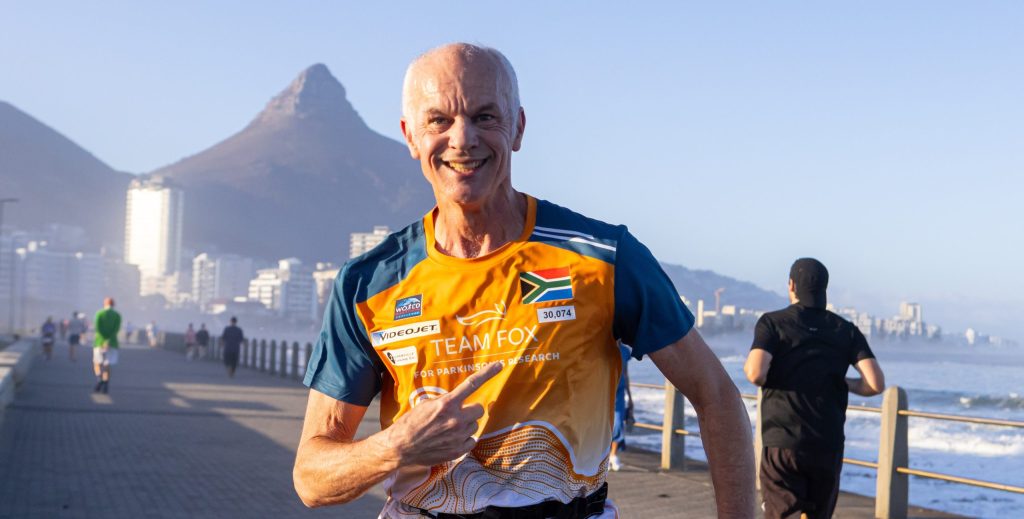
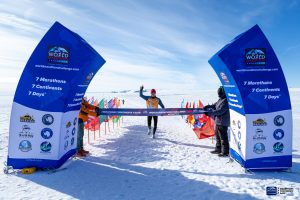
For fellow Team Fox athlete Lincoln Bode, HPP’s epic Pacific row sparked an extraordinary endurance feat of his own in honor of his late father Hank, who lived with Parkinson’s: the 2026 World Marathon Challenge, which less than 300 people have ever completed. Over seven consecutive days, Lincoln ran seven half-marathons across all seven continents—from the frozen tundra of Antarctica to the blistering heat of Perth, Australia. And all of this at age 63 and with two artificial hips. Lincoln raised over $77,700 for MJFF.
As HPP’s Second Wave team prepares for their upcoming Great American Loop row—led by captain Ashley Ellis, who lives with early-onset Parkinson’s—we spoke with Lincoln to discuss his global odyssey, his emotional journey honoring his father, and how HPP directly sparked his mission.
Q: You told HPP’s founder, Patrick Morrissey, that you consider HPP directly responsible for pushing you toward the World Marathon Challenge. How did that happen?
Patrick and Team HPP gave me the idea to run the 777s! My dad and I monitored the research successes of The Michael J. Fox Foundation. Each year, we’d sit down and review the foundation’s pamphlet featuring all these neat stories, and that’s where we first read about HPP. Frankly, we couldn’t fathom what HPP did—rowing from California to Hawaii! I still get goosebumps thinking about it.
We took out my cell phone, opened up Google Maps, traced their route, and marveled at the odyssey of their adventure. My father looked at me and said, “Sounds like some of the races you’ve done over the years.” And that’s what planted the seed of running the World Marathon Challenge in honor of my father and to raise funds and awareness for MJFF.
When I finally met Patrick in person while in Washington, D.C., while advocating for Parkinson’s legislation, it was a dream come true. I gave him a hug and told him, “I still consider it ‘your fault’ for getting me into Team Fox 777!”
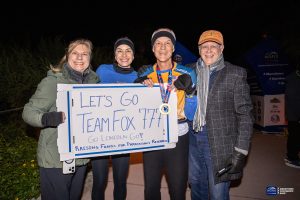
Q: Your late father, Hank, was the anchor behind this run. Tell us about deciding to run in his honor.
My dad was an incredibly accomplished, independent man—a Navy nuclear engineer, corporate president, and tenor in the choir. When he was diagnosed with Parkinson’s in 2016, it surprised the entire family. Nevertheless, he didn’t let it get him down. Every day he did his best to live life to its fullest.
Personally, I run to release stress, daydream, and pray. During a run after a visit with my dad, a clear thought hit me: Run for Parkinson’s, just like HPP rowed to Hawaii.
Because of my two artificial hips, running full marathons was a risk, so I emailed the World Marathon Challenge organizers and got permission to run half marathons instead. Once they cleared it, I took the idea and my $77,700 fundraising goal—the sevens being symbolic for the challenge—to my dad to ask his permission to run on his behalf. He took a day to think about it before saying yes, at which point he also told me, “About that financial target…I think you could do more.” That was inspiring.
My dad was realistic, knowing that the research may not benefit him, but he was willing to pay it forward. He passed away at age 91 on January 27, 2025—almost exactly one year before I arrived in Cape Town to start the challenge. But I knew he was with me on the start line.
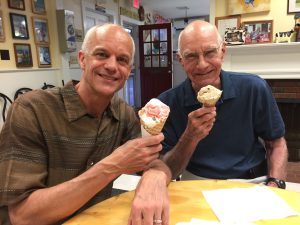
Q: You have a fascinating background, both professionally and athletically. How did your early years shape the mental resilience needed for extreme endurance?
I was born in Alabama, grew up in Oak Park, Illinois, and spent 17 years living abroad in Europe and Singapore. That was all while building an international distributor operations for Videojet Technologies—the company my father, Hank, ran as president for nearly two decades. Over the years, I learned to love the international arena and treat everyone with respect.
Athletically, the foundation was built at Augustana College, where I competed as a decathlete under a fantastic mentor, Coach Paul Olsen. In the decathlon, you have 10 events with only 30 minutes between each discipline. Coach Olsen taught us that if you have a bad throw, vault, or run, you have to get over it immediately because the next event is waiting. He instilled in me a deep confidence that if I fail, I can get right back up and keep moving. I’ve incorporated the fundamentals of his training program ever since.
After college, grabbing running shoes was the easiest way to stay active, but my real core—adventure racing—blossomed in 1998 while living in Singapore. I like mixing up trail running, mountain biking, and kayaking. Over the years, I’ve completed more than 50 adventure races across 14 countries, including a 100-mile run in the Himalayas, 100K run in Mongolia, and 1,000K adventure race across Vietnam.
Q: What was it like to race across the world in seven days? What stood as the highs and lows?
The most beautiful, glorious stage was Antarctica. We landed at 2:30 in the morning, and the sun was still hanging two inches above the horizon. We started running at 3:30 a.m. in freezing winds, surrounded by a vast white tundra that went on forever. The ruggedness and wilderness gave me an immense respect for nature. When the headwinds got brutal, I remembered that my dad was a sailor as a boy. He was used to tacking into the wind, so as I ran, I pictured myself tacking to get the wind at my back.
The hardest leg was Perth, Australia, because of the 104-degree heat, even though the race started in the late afternoon. The sun was just so harsh. On an exposed one-mile stretch next to an inlet with zero shade, I was so exhausted I stopped running and started to walk, but it was still too much so I stood and put my hands on my knees to catch my breath. I wanted to quit. But in that moment, a thought hit me: I bet Dad wanted to quit Parkinson’s. I bet my teammates living with Parkinson’s would love to wake up and quit having it. That changed my perspective. I stood up, walked to a patch of shade that felt refreshing, and regrouped. I asked my dad for strength, thought of everyone who donated, and kept moving.
Crossing the finish line in Perth, I was exhausted beyond anything I had ever done, but it was the first time I knew I would finish the rest of the challenge.
Q: You wore a unique jersey during these races that caught a lot of attention. Can you explain the design?
We printed each country’s flag on the shirt, paired with the number of people living with Parkinson’s in that country underneath it. Antarctica was the only shirt without a number, because there is no permanent population!
While running, my daughter texted me that people were flooding our social media comments saying things like, “My mother is one of those numbers on your shirt,” or “My uncle is included in what you’re wearing.” It gave me motivation to run, and I realized this wasn’t about me. It was about the wider Parkinson’s community and paying it forward. And at the end of each of my seven runs, I would say, “We crossed the finish line together.”
Q: Your daughter, Amber, managed your social media. What was it like having the next generation involved in honoring Hank’s legacy?
Amber developed my Instagram page because I didn’t have a clue! She gave me instructions on how to film myself while traveling and on course. I sent her gobbly-goop video, and she turned it into magic. Thanks to her, our campaign reached 2.9 million views. We communicated almost every day, which made for a beautiful daddy-daughter bonding experience. She and her grandpa Hank had a special relationship, so she was happy to contribute on his behalf.
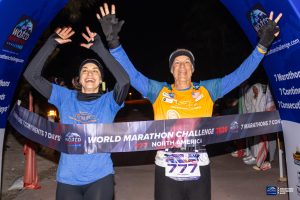
A highlight was the final leg in Miami. You live in a bubble during the challenge—you run, eat, get on a plane, sleep, and repeat. By the time we reached Miami for an 11:00 p.m. start, I was knackered. Amber texted me: “Dad, you can say no if you want, but can I run this with you?” I was so excited. The organizers cleared it, and she ran with me. There is a professional photo of her bouncing on her way with a big smile, while I look like a drained horse. Crossing that final finish line together, we both held up our hands with the number 7!
Q: Now that the sevens are behind you, what’s next for your athletic career and your work with the Parkinson’s community?
Recently, I traveled to Capitol Hill in Washington, D.C., with The Michael J. Fox Foundation, and I’ve also been working at the state capitol in Springfield, Illinois, to help push forward the idea of removing or banning Paraquat, a herbicide linked to Parkinson’s disease. Those are two very unlikely places I would have said I would find myself.
Athletically, the next step is to take it a lot easier on my hips! My next events are inline roller skating marathons in Berlin, Germany, and Sarasota, Florida. It gives you that feeling of sway without beating up the hips.
When people in my local coffee shop find out about the 777 challenge, they often say, “There’s no way I could ever do that.” But you know what? I still feel that way about what Team HPP did. Patrick told me it was extremely hard in the moment, but his story motivated me to run the World Marathon Challenge for Parkinson’s.
People may not be in a position to row an ocean or run a series of marathons in a week, but they can all find movement that is achievable and meaningful for them.