How Patrick Morrissey Took on Wrestling, Parkinson's, and the Pacific Ocean
“I always talk about finding a cure in my lifetime, not just finding a cure.” – Patrick Morrissey, Team HPP First Wave Crew Member
For Human Powered Potential (HPP) crew member Patrick Morrissey, that’s not optimism. It’s a plan. He learned early that nothing worth having comes without a test. As the first person diagnosed with Parkinson’s to row the mid-Pacific as part of the World’s Toughest Row-Pacific, he’s no stranger to challenge.
Growing up in Durango, Colorado, his world was built on sports and the outdoors: water/snow skiing, football, basketball, baseball, and above all, wrestling. On the mat, there’s nowhere to hide. No teammates to carry you. It’s just you, your opponent, and whatever you’ve earned through preparation and will. The record speaks for itself. He went 26-0 his senior year at Durango High School, winning the 1989 Colorado State Wrestling Championship. He earned All-America honors in Greco-Roman at the Junior Nationals. He got a scholarship to Cal Poly, San Luis Obispo, a Division 1 wrestling program. After redshirting his first year, he wrestled varsity the next four years, finishing third at the Pac-10 Conference tournament and placing in the top 12 at the NCAA Championships his senior year. Patrick also received a bachelor’s degree in engineering science.
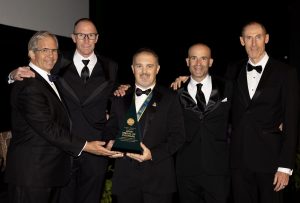
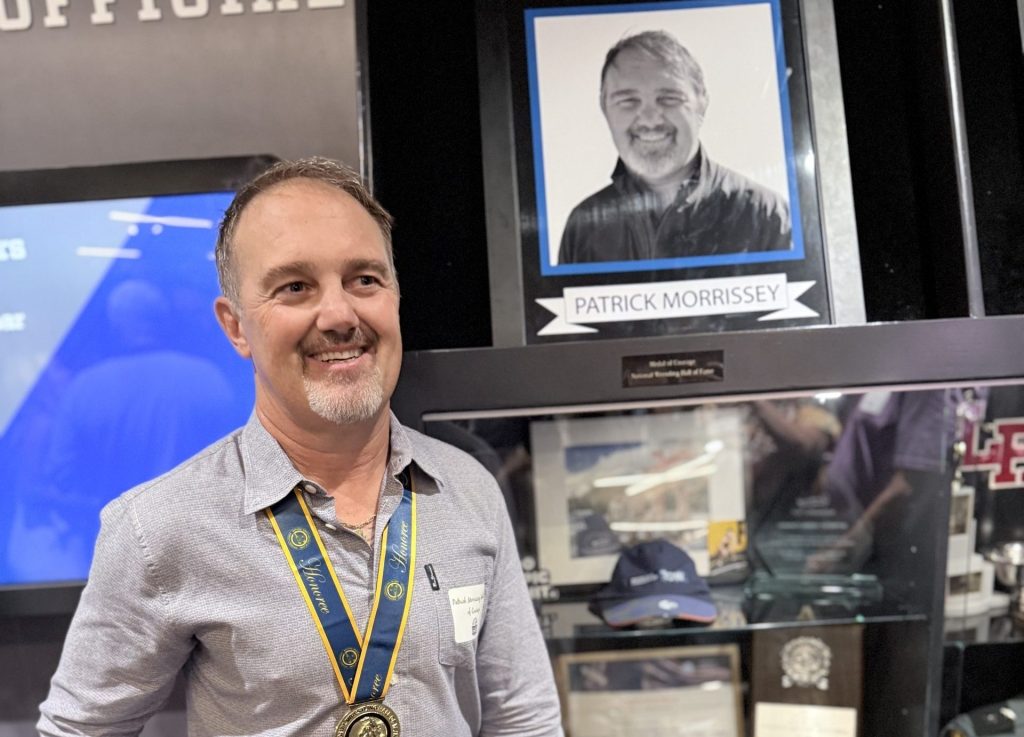
On June 6, the National Wrestling Hall of Fame recognized Patrick with its Medal of Courage award, given to a wrestler who has overcome what appear to be insurmountable challenges and provided inspiration to others. The nomination came from a fellow wrestler, whose wife is living with Parkinson’s disease. He was so moved by his row across the Pacific that he nominated Patrick to be a Medal of Courage recipient. It’s an honor that threads the needle between what Patrick learned from wrestling and who he’s become since: a warrior whose discipline now serves a different kind of purpose.
The diagnosis came in 2019. Early-onset Parkinson’s disease.
Patrick was 48 years old when he was diagnosed. He’d built a full life after wrestling. Thirty years in engineering and real estate, rising to President and COO of GF Properties Group. A marriage of 32 years to his wife Dena. Two daughters, Lauran and Mara. And continuing his passion for athletics: mountain biking, hockey, skiing, and bike races like 24 Hours in Moab and the Iron Horse Bicycle Classic. Movement and exercise were always a foundation of Patrick’s world.
Then Parkinson’s began changing the terms.
Initially, he kept his diagnosis private, but eventually confided in his close friend, Brendan Cusick. Brendan and fellow teammate Scott Forman had already secured the American Spirit boat for the World’s Toughest Row-Pacific from California to Hawaii, and also recruited Peter Durso to join the team. They had also decided to fundraise for The Michael J. Fox Foundation for Parkinson’s Research (MJFF). At the beginning, Brendan asked Patrick if he would be a spokesperson. It was early in Patrick’s diagnosis, and he thought this could be a great way to get involved with MJFF. But they were still searching for the fourth rower, and Patrick couldn’t shake a question: “What if I became the fourth?”
The wrestler in him knew what it would take. He understood preparation, discipline, and pushing past the body’s protests. He spoke with Brendan, and then after meeting with Scott and Peter, Patrick became the fourth member of Team Human Powered Potential.
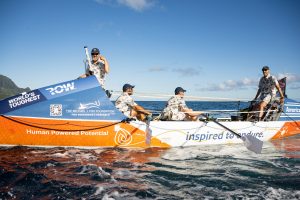
What followed was 18 months of rigorous training: daily strength work, stretching, aerobic and anaerobic conditioning, and monthly team sessions on the boat. On June 8, 2024, Team HPP launched from Monterey, California. For 41 days, the four-man crew rowed 24 hours a day in two-hour shifts, facing 30-foot waves and up to 50-mile-per-hour winds. Patrick managed his Parkinson’s symptoms on the open ocean, adjusting his medication schedule around his rowing shifts, sometimes unable to keep his medication down due to seasickness. The team adapted around him. When he needed rest, his teammates took over. When he came back, he rowed.
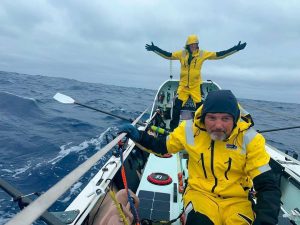
There were moments of stillness that tested him differently than the waves. He described one stretch of dead calm: “The water was an ominous blackish color, no wind, no sound, nothing but the ripples from their oars. I thought of it as a painting, a surreal image I felt trapped inside, with no way out but forward.”
And then there was Hanalei Bay. After 41 days of salt, sweat, and survival, Patrick was reunited with his wife Dena, his daughters, and his friends on the shore.
“That was the moment I realized I had out-rowed the limitations the diagnosis tried to place on me in 2019.”
In those 41 days, Patrick Morrissey became the first person diagnosed with Parkinson’s disease to row across the mid-Pacific Ocean. The expedition raised $43 million for The Michael J. Fox Foundation, $2 million more than the final $41 million goal.
Today, Patrick has retired from his corporate career because of Parkinson’s, but retirement hasn’t slowed him. He serves on the MJFF Patient Council, bringing his engineer’s mind and his patient’s perspective to advise on research and community outreach. And his advocacy has expanded well beyond the water.

In March, Patrick and Dena attended an MJFF fundraising event in Palm Beach, Florida, where a short film, narrated by Michael J. Fox, was shown to highlight Human Powered Potential’s record-breaking row. Patrick also participated in a panel discussion focused on the state of Parkinson’s, moderated by MJFF CEO and Co-Founder Debi Brooks. The panel also included Mark Frasier, PhD, MJFF’s Chief Scientist, and Dr. Susan Bressman, MD, the Mirken Family Professor of Neurology at the Icahn School of Medicine at Mount Sinai and one of the leading neurologists advancing Parkinson’s research today. The panel spotlighted the current state of Parkinson’s research, including more than 175 drugs now in development aimed at slowing disease progression and improving quality of life, a pipeline that didn’t exist at this scale when MJFF was founded 25 years ago.
Also in March, Patrick and Dena headed to Capitol Hill for the Parkinson’s Policy Forum, urging members of Congress as a patient advocate to prioritize three critical policy areas:
- Increasing federal investment in research at a time when the annual economic impact of Parkinson’s in the United States has reached over $82 billion, with 1.2 million Americans currently living with the disease. The number of people living with Parkinson’s worldwide is projected to grow to more than 25 million by 2050.
- Supporting the HEALTHY BRAINS Act, bipartisan legislation that would direct the NIH to research the relationship between pesticides and other environmental risk factors and neurodegenerative diseases including Parkinson’s, Alzheimer’s and ALS. The bill was initially introduced last Congress but did not advance before the session ended and is expected to be reintroduced soon. However, states are leading the way to progress. On May 26, 2026, Vermont made history as the first state in the nation to ban paraquat, a highly toxic pesticide that more than doubles the risk of developing Parkinson’s for those who apply it. It’s a chemical that over 70 countries have already banned, including China and the European Union, yet it remains in use on American farms. Vermont’s ban is a turning point. MJFF and its coalition partners led the push for the legislation, and the Foundation is now advancing paraquat bans in a dozen more states to help accelerate federal legislation.
- Implementing the National Parkinson’s Project, a landmark in Parkinson’s policy: the first-ever federal initiative dedicated to preventing, diagnosing, treating and curing Parkinson’s disease. The National Plan to End Parkinson’s Act was signed into law in July 2024 after years of grassroots advocacy and overwhelming bipartisan support, with 215 senators and representatives co-sponsoring the legislation. In April 2026, the law’s Advisory Council was formally announced, with MJFF CEO Debi Brooks among its inaugural members, and its first meeting is scheduled for June 29, 2026. This was hard-won after the project had stalled and it took sustained pressure from the Parkinson’s community to push Congress to act.
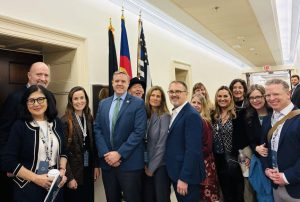
In April, Patrick and Dena participated in the annual MJFF Patient Council meetings in New York City. The Patient Council, established in 2009 as a formal channel to receive input from Parkinson’s patients and the broader Parkinson’s community, advises the Foundation.
Also, in April, Morrissey joined more than 3,000 people and families who filled Central Park for the 2026 Parkinson’s Unity Walk, one of the longest-running and most significant community events in the Parkinson’s world. Now in its 32nd year, the walk raised nearly $2 million for MJFF’s research and policy priorities. Events like the Unity Walk are proof that movement is more than personal medicine; it’s a vehicle for community, connection, and collective action.
Patrick’s approach to Parkinson’s carries the same discipline that defined his wrestling career. Exercise has transitioned from something he did to be competitive to something that’s non-negotiable, a daily requirement that research shows may help delay the progression of Parkinson’s. The lessons the wrestling mat taught him—preparation, endurance and the refusal to be pinned down—are the same ones carrying him forward today. The challenge isn’t over. Parkinson’s is progressive and there is no cure yet. But every mile rowed, every policy maker sat with, every walk through Central Park alongside thousands who share this mission, is evidence of what one person can do when they refuse to stay down.
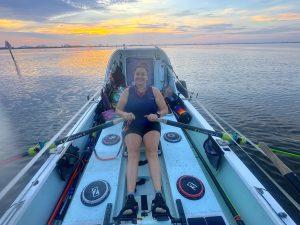
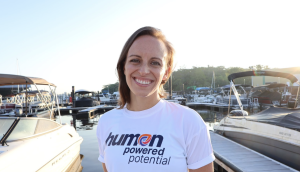
Patrick is also excited about HPP’s next chapter, a new endurance challenge to fuel adventure philanthropy funding for Parkinson’s research. The all-female Second Wave team, including captain Ashley Ellis, who is living with early-onset Parkinson’s, is preparing to row the Great American Loop through America’s waterways in 2027, continuing the mission HPP started. When asked what advice he has for the Second Wave team preparing for their own +5,000 nautical-mile row around the Great American Loop, he says:
“When you put yourself around the right people, you can accomplish anything. Trust your team, be vulnerable and ask for help.”
Looking ahead, his vision for HPP isn’t just about one crew or one ocean. “I don’t want HPP to simply be ‘four guys who rowed the Pacific’,” Patrick says. “I hope that by 2030, HPP has inspired a community of athletes, including many living with Parkinson’s, to complete extreme physical challenges to help fund Parkinson’s research. Whether it’s climbing peaks, cycling continents, or rowing oceans, I hope HPP has provided the blueprint for turning physical grit into a cure.”