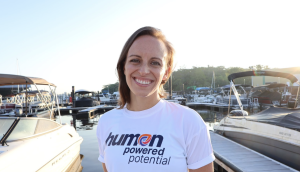
Meet Dawn Smith, Second Wave Team Coach
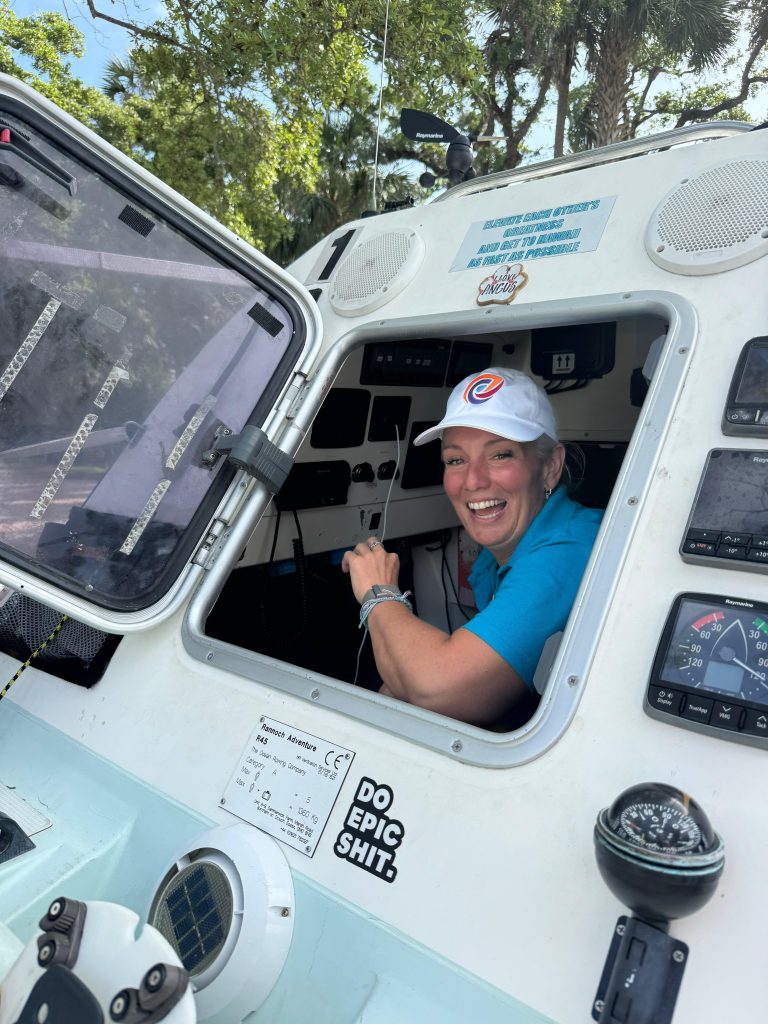
An elite ocean rower, former police boat skipper, and commercial mariner with over 25 years of experience, Dawn Smith knows exactly what it takes to survive—and thrive—on the water.
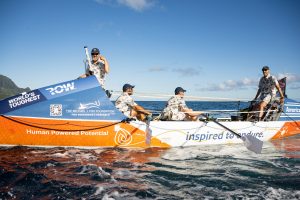
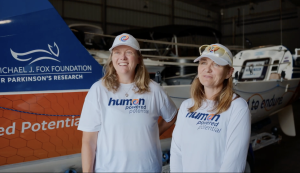
Dawn, who has rowed six oceans and holds the world record for the most ocean rows and most nautical miles completed by any female, recently teamed up with Human Powered Potential (HPP) to coach the Second Wave team as they prepare for their historic attempt to row the +5,000-mile Great American Loop to help raise awareness and funds for The Michael J. Fox Foundation for Parkinson’s Research.
We sat down with Dawn during the Second Wave team’s week-long training intensive in Orlando, Florida, to discuss what it takes to prepare for HPP’s next extraordinary feat of human endurance, what the team will need to be ready for on the Great American Loop row, and her own upcoming row across the Atlantic—from Newfoundland to her hometown in the United Kingdom.
Q: Tell us a bit about your background. How did you first get connected with the Second Wave team?
Alongside ocean rowing, I’ve been a commercial mariner for 25 years, and I’ve rowed around Scotland and most of the UK coast. My rowing teammate, Paul Lore, lives in Florida and first became connected with the Human Powered Potential team. Paul and I had recently rowed 3,000 miles across the Atlantic from La Gomera, Canary Islands, to Antigua as part of the World’s Toughest Row. Paul basically told the Second Wave team, “You need to get Dawn over here to come and do some coaching!” So, that was it! I’m grateful Paul introduced me to this incredible group of rowers. The Michael J. Fox Foundation is an amazing charity with the work they’re doing to end Parkinson’s, so I’m excited to support this row.
Q: You were the first female police boat skipper and one of the first female firearms instructors in the Essex Police. You’ve broken a lot of barriers. How does that connect to the Second Wave’s expedition?
I’ve broken down quite a few barriers in my career. It’s all about trailblazing and showing people what’s possible. If the Second Wave team is successful, they won’t just be the first females to row this route—they’ll be the first people ever. It’s going to be really exciting to follow along with their journey.
I’ll be 50 years old when I set off for my next row from Canada back to the UK this June. When my rowing mate and I complete it, we will be the first mixed pair to do so, and I will have rowed my seventh ocean. This isn’t an age thing. People have done these rows at 18 and in their 70s. You don’t have to fit into a specific box to achieve something like this. What these women are doing is showing girls, women, and honestly everyone, that if you set your mind to something, you can achieve it.
Q: The Second Wave team is using an ocean-going boat, but the Great American Loop isn’t the open ocean. How are you helping them adapt?
Ocean rowing is amazing—obviously, I love it because I keep doing it! But this expedition is just something a bit different. The Great American Loop brings a whole new set of challenges. You’ve got tides and inland waterways, and you are constantly going to be doing passage planning the entire way around the loop. So, I’m drawing on all the skills I’ve gathered over the last two decades—ocean rowing, coastal rowing, river rowing, and lock management—and putting it all together for them.
When I rowed around Scotland, we encountered the “Neptune’s Staircase”—which is a series of about 12 locks where you end up rowing uphill! That’s one of the major things the team is going to encounter: lock systems. We’ve also got a lot of navigation training. When rowing oceans, there’s only one place you’re aiming for normally, whereas the Loop will entail constant navigation.
Q: Unlike an open ocean row, the Great American Loop offers places where the team could easily quit. How does this change the experience?
In some ways, that actually makes the challenge more difficult. I remember vividly when I did my first solo row, I was slap bang in the middle of the Atlantic Ocean. My brain was telling me, “You can’t do this anymore. That’s it. You’ll run out of energy.” But two hours later, I was still rowing. Why? Because there was no other option. And then, of course, 40-odd days later, I was still rowing, because there was no other option.
And it proves that everybody’s capable of a lot more than you give yourself credit for. It’s the mental resilience. You can be as fit as anything, the best rower in the world, but if you can’t mentally deal with being out on the water, then it’s not going to work. What makes extreme athletic endeavors like this unique is not just physical strength, but mental resilience as well.
With the Great American Loop, you need a lot more mental resilience to actually be able to say, “No, I’ve put myself in this situation, and I’m going to keep it through.” The advice I give people to deal with that is simple: What is your why? You have to be completely honest with yourself. If your heart isn’t truly in it, then when the chips are down and you want to get off that boat, a superficial reason won’t keep you going. What makes this team so special is that their why is clear. They know exactly why they are rowing—to raise funds to find a cure for Parkinson’s disease—and that is what will stop them from going home when they’re halfway round.
Q: What else are you focusing on in training?
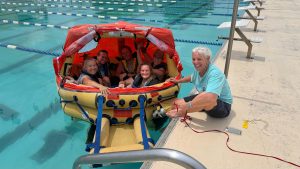
They are already amazing rowers, so they don’t need to learn how to row. What they need to learn is how this specific boat operates and what to do in emergency situations. If you have equipment on board but you’ve not been trained on how it works, it’s useless. So we’ve gone through the Rannoch R45 American Spirit boat and its onboard systems from front to back. We also have emergency sea survival and night rowing training, since they’ll be on the water 24/7 for several months in all kinds of weather.
This team is absolutely brilliant. They ask the right questions, they’re constantly communicating, sorting things out, and rallying round whenever someone has a question. In fact, they get on so well it’s sometimes difficult for me to get a word in! It’s really great to see. Hopefully by the end of the week, they’ll have gone from amazing rowers to amazing loop rowers!
Q: If people take just one thing away from your story, what do you want it to be?
I want them to see that you don’t have to be a traditional athlete to achieve things. I’m 5-foot-5. I don’t look like a traditional rower, and I’m not a natural athlete. I have had to try incredibly hard at everything I have ever achieved in my life, both in sports and in my 26 years in the police force. You don’t get things handed to you on a plate. You have to work hard for it—but if you do, the benefits are just amazing.