Not Your Average Looper ~ Ashley Ellis
Editor’s note: This article was originally written by the America’s Great Loop Cruisers’ Association.
It’s pretty uncommon to do the Great Loop in your 40s. It’s even more unusual to do it as a crew of six women. Add the fact that these women will be rowing the Great Loop to raise awareness for Parkinson’s disease, and the result is a truly unique and inspirational story.
Ashley Ellis was diagnosed with early-onset Parkinson’s nearly 5 years ago, just after she turned 40.
“Of course I was sad,” Ashley said. “I was shocked—all the things. When I was first diagnosed, I really hid it and didn’t tell people. There was some kind of shame or embarrassment. I just wanted it to go away. But then I decided that’s not how I’m going to live. I’m going to speak up and do what I can to fight for myself and other people.”
A former college rower, Ashley decided to lean into the proven benefits of exercise for people with Parkinson’s. She began running again and got back into rowing.
When Ashley and her rowing friends began discussing the possibility of rowing the Great Loop, they searched for a suitable boat, and kismet intervened.
Ashley called about an ocean-rowing boat that was listed for sale. On the other end of the phone was Anna. After hearing Ashley’s story, Anna—who Ashley now considers a good friend—asked, “If you’re a rower and you have Parkinson’s, have you heard of Human Powered Potential?”
Human Powered Potential first came into the public eye when a team rowed from Monterey, California, to Hawaii, raising $43 million for The Michael J. Fox Foundation. Anna introduced Ashley to Human Powered Potential team member, Patrick Morrissey, the first person diagnosed with Parkinson’s disease to row across the Pacific Ocean.
The idea for Human Powered Potential’s Second Wave was born.
“All of this has caused me to live urgently,” Ashley said. “You only live once. But really, whether you have Parkinson’s or not, that’s true for all of us.”
The Second Wave
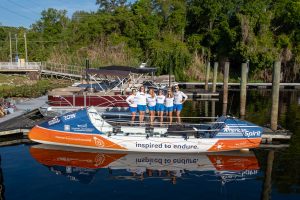
Ashley and her team—now known as the “Second Wave” of Human Powered Potential—will be rowing the same boat Patrick and his teammates used to cross the Pacific. The vessel, American Spirit, is a Rannoch R45 with a length of 28 feet, three rowing positions, and berths at the bow and stern. Their goal is to take on the Great Loop beginning in late March 2027 from likely the New Orleans area.
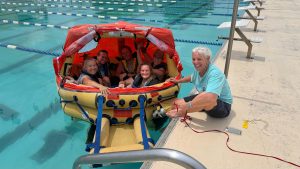
The women are currently training, learning, and preparing for the journey ahead.
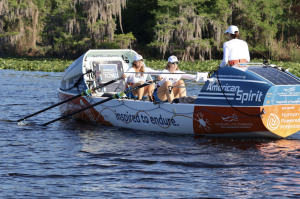
Their plan is to row continuously, with the six women rotating through shifts of two or three rowers while the others eat, rest, and prepare for their next watch. They’re studying weather patterns and currents and learning how to use those forces to their advantage. When conditions are unfavorable, they may choose to anchor and rest. When the current is working in their favor, they’ll use that extra push to cover additional miles with less physical effort.
The team has allotted four months to complete the Great Loop—about all they can spare from work, family, and other life obligations. While that’s a shorter timeline than many Loopers choose, it’s what the women determined was realistic given their responsibilities at home.
Those responsibilities are significant. Two members of the crew are sisters whose mother has Parkinson’s disease, and one serves as her primary caregiver. During my video call with Ashley, one of her three children overheard our conversation and jumped in with concerns about whether his mom would have access to her medication while she was away.
It’s a reminder that this journey isn’t just about rowing. It’s about balancing ambition, family, caregiving, and life’s everyday realities.
While Ashley is certainly not your average Looper, there are many ways in which she’s just like the rest of us. Initially, she defined success as completing the route within the four-month window the team had established. But as the planning progressed, her perspective evolved.
She realized that checking the box for completion isn’t the only measure of success on the Great Loop.
“My heart has opened to the idea that success really looks like investing in my teammates and supporting each other as a crew,” Ashley said. “It’s about having that human experience of learning and growing together while facing fear and pursuing adventure.”
Throughout our conversation, Ashley was quick to shift attention away from herself. She spoke more often about her teammates, the mentors who inspired the effort, and the mission behind it than about her own diagnosis. Even while preparing for one of the most ambitious Great Loop adventures in recent memory, she seemed far more interested in highlighting others than in discussing her own role.
Be on the lookout for Human Powered Potential’s Second Wave team on the waterways next spring. They’ll be relying on Harbor Hosts along the way for much-needed local knowledge and support. Ashley hopes to conduct some public outreach during the journey, though the realities of a four-month schedule mean the boat will need to keep moving. The team also plans to connect with local rowing clubs and invite rowers to join them for portions of the route.
Rowing the Great Loop in four months is an ambitious challenge. Ashley says the team is optimistic—but also realistic. Beyond completing the route, the true goal is human connection and spreading hope for those who are impacted by Parkinson’s disease.
“My goal with my kids is to show them that when we face struggles, when we hit obstacles, and when hard things happen, we can show up and not let those things define us,” Ashley said. “Parkinson’s is a big part of my life. I have my tremor. But it doesn’t define me. And I’m not going to hide it.”
If the Second Wave team succeeds in inspiring others to face life’s challenges with courage and determination, they’ll have accomplished something remarkable long before they cross their wake.